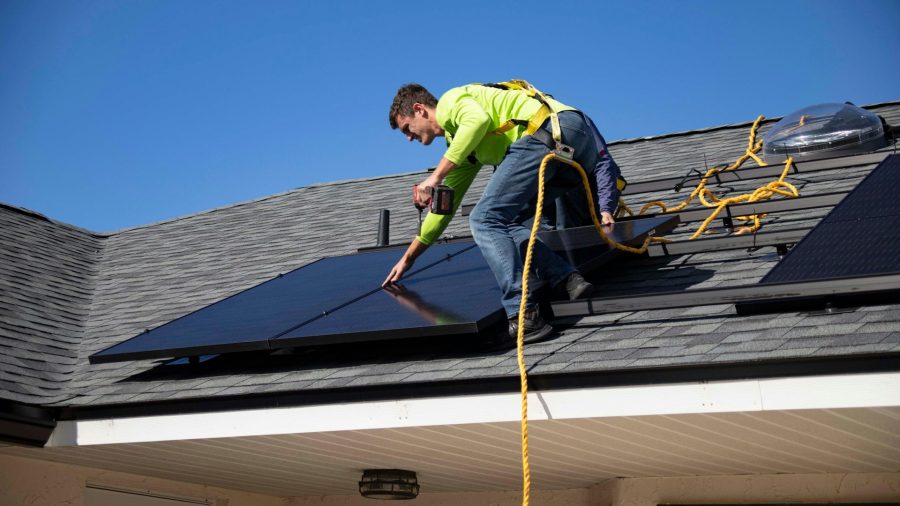
Solar Panels Cannot Legally Go in a Skip, and the FIT Generation Is About to Find Out
The Feed-in Tariff opened in April 2010 and the rush that followed put solar panels on several hundred thousand British roofs in about five years. Almost every conversation at the time was about the front end: the tariff rate, the payback period, the degression deadlines, whether to install before the next rate cut.
Very few of those conversations covered what happens at the other end, because in 2011 the other end was twenty-five years away and felt theoretical.
It is not theoretical now. Panels installed in the FIT boom are fifteen years old or thereabouts, some are being replaced early, storms and defects take out a few thousand more each year, and the households involved almost universally assume that a dead solar panel is a large flat piece of glass and aluminium that goes in a skip with the rest of the building waste.
That assumption is wrong, and it is wrong as a matter of law rather than as a matter of good practice.
A solar panel is legally classified as electrical waste
The exclusion is neither obscure nor contested. Skip hire exclusions published by easySkip list “fridges, freezers, TVs, monitors, and any other electrical goods” among the items that cannot go into a standard mixed waste skip, and a photovoltaic module is unambiguously an electrical good. The Waste Electrical and Electronic Equipment Regulations brought PV panels formally into scope in 2014, placing them in Category 14 alongside other large electrical equipment, which means a solar panel is treated in law exactly as a television is.
The practical consequences follow from that classification rather than from anyone’s environmental preferences.
Panels cannot go into a mixed skip. They cannot go into a general waste bin. They cannot be sold to a scrap dealer for the aluminium in the frame, which surprises people, because the frame genuinely is worth something and every instinct says to cut it off. They cannot be taken to a standard household waste recycling centre, which is not equipped for WEEE of that size.
What they require is collection by a licensed carrier and processing at an Approved Authorised Treatment Facility, where the panel is taken apart rather than crushed: frame off, glass separated, then thermal or chemical processes to recover silicon, copper and silver from the cells.
Skip operators are not licensed to accept this category, which is why a panel discovered in a load at collection becomes a specialist disposal charge rather than a shrug.
The recycling has almost certainly already been paid for
This is the part that would improve most people’s day if anybody told them.
The WEEE framework runs on extended producer responsibility, meaning the manufacturer or importer who first placed the panels on the UK market carries the financial obligation to fund their eventual collection and recycling. Producers meet that obligation by registering with an approved producer compliance scheme and paying into it. The Environment Agency approves those schemes and publishes the list of them, and several operate specifically in photovoltaics.
So for a domestic installation, the cost of recycling was built into the panel price years ago. A homeowner should not be paying a recycling fee at the end of life at all.
What a homeowner does pay for is the physical work of getting the panels off the roof, which is a separate job involving scaffolding, electrical isolation and labour, and which no compliance scheme covers. Confusing those two costs is how people end up being quoted several hundred pounds for “disposal” and concluding that the skip was the sensible option after all.
The first call is to the original installer, who often retains collection obligations under whichever scheme they belong to.
If the company that installed them has gone
Given that panels last twenty-five to thirty years and that a great many FIT-era installers did not, this is a common situation rather than an edge case.
The obligation does not vanish with the company. A householder can approach a producer compliance scheme directly, or arrange collection through a licensed waste management firm that handles PV.
There is one date worth knowing. The WEEE framework uses 13 August 2005 as the boundary for assigning financial liability. Panels placed on the market after that date sit with the producer under extended producer responsibility. Anything before it is classed as historic waste, and where old equipment is being replaced with new, the supplier of the replacement is generally the one who absorbs the historic disposal cost. Almost every FIT-era domestic installation falls on the post-2005 side of that line, which is the favourable side.
Why this is becoming a real volume problem, and when
At present the UK generates something in the order of 650 to 1,000 tonnes of end-of-life panel waste a year. That is a small number, and it is small for a straightforward reason: most British installations are still under fifteen years old and nowhere near the end of a twenty-five to thirty year design life.
The arithmetic changes from the middle of the 2030s. The panels that went up during the FIT boom did so in a compressed window, which means they will reach end of life in a similarly compressed window. A scheme that installed at pace produces waste at pace, roughly a generation later.
UK recycling capacity is adequate for current volumes and is being expanded ahead of that wave. The relevant point for anyone reading this today is simply that the household deciding what to do with a panel in 2027 is early, not late, and early is a much easier position from which to get it right.
Do not recycle a panel that still works
Worth saying plainly, because “it is WEEE” can be read as “it must be scrapped”.
A panel that is underperforming is not necessarily finished. Output degrades slowly and predictably, typically to somewhere around 80% of original after twenty-five years, so a fifteen-year-old panel producing less than it did is behaving normally rather than failing. Check the warranty position before anything else, since performance warranties frequently run twenty-five years and outlast the installer’s own business.
Panels removed during repowering, meaning replacement of functioning equipment with more efficient equipment, have a genuine second-hand market. Recycling is the right answer for panels at twenty-five years and for broken glass. It is a waste of a working asset otherwise.
What skip hire is actually for on a solar job
None of this means a skip has no place on a solar project. It means the panels are not what goes in it.
The real waste stream on a domestic solar job is the roof. Panels need a roof with twenty to twenty-five years of life left in it, because taking an array off to replace tiles underneath costs more than doing the roof first, so a significant number of installations trigger roof work as a precondition. That produces old tiles or slates, felt, battens, sometimes a full strip back to the rafters, and it is exactly the dense, heavy, inert material a skip exists for.
The same applies at the other end of a system’s life. If an array comes off and the roof is made good afterwards, the tiles, mortar and timber from that work are ordinary construction waste going in an ordinary skip. Only the modules themselves peel off into the WEEE stream.
The clean way to run it is to treat them as two separate disposal routes booked at the same time: a skip for the building fabric, a compliance scheme or licensed WEEE carrier for the modules. Trying to make one container do both jobs is what produces the charge at collection.
One safety point that catches out competent people
A solar panel generates voltage whenever daylight falls on it, whether or not it is connected to anything.
Disconnecting the inverter does not make an array safe to handle, and a module lying face up in a garden on a bright day is live. Removal involves working at height, certified electrical isolation and safe disconnection from the grid tie-in, which is why it is a job for a qualified installer rather than a confident weekend.
There is a paperwork dimension too. Moving waste of this classification without the appropriate waste carrier registration is an offence, so the person taking the panels away needs to be entitled to take them.
The short version
A solar panel is a television as far as the law is concerned. It cannot go in a skip, the recycling was funded when it was manufactured, and the compliance scheme rather than the householder carries that cost.
The FIT generation is arriving at this question first, roughly a decade before the volume becomes national news. Getting it right is a phone call to an installer or a compliance scheme, and getting it wrong is a specialist disposal charge on a skip invoice for something that was already paid for fifteen years ago.
Share It on :