Carpet Choices That Protect Indoor Air Quality in Energy Efficient Homes
Your home is sealed tight. That’s the point — less heat escaping means lower bills and a smaller carbon footprint. But here’s the thing: everything you bring inside stays inside a lot longer than it would in a drafty Victorian terrace. Including whatever’s coming off your carpet.
Choosing the right carpet matters more in energy efficient homes than most people realise. With air exchanges happening less frequently, emissions from flooring materials, adhesives, and underlays have nowhere to go. They just… linger.
The Airtightness Problem Nobody Talks About
Energy efficient design is brilliant at keeping warmth in. It’s less brilliant at flushing out indoor pollutants. Dust, allergens, volatile organic compounds (VOCs) — all of it builds up faster when ventilation is reduced to preserve energy.
Soft furnishings are a significant source of indoor emissions. Carpets especially. And yet most people pick flooring based on colour and price. That’s understandable. It’s also worth looking a bit deeper.
What’s Actually in Your Carpet
Not all carpet is created equal.
Wool is the standout natural option — generally lower in chemical emissions than many synthetic fibres, and it doesn’t need the same level of chemical treatment to achieve durability. That said, even wool carpets can come with backing layers, adhesives, or stain-resistant finishes that introduce VOCs.
Synthetics like nylon and polyester are widely used and often more affordable. The manufacturing process — dyeing, treating, bonding fibres to backing — can leave residual substances that off-gas after installation. Some do this for weeks.
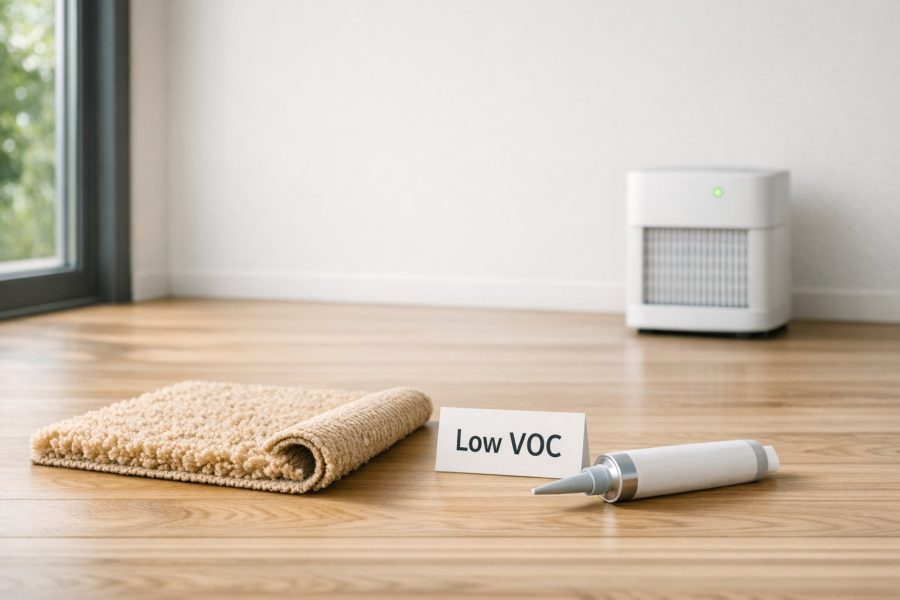
The key question to ask any supplier: does this carpet carry a low-emission certification? Look for labels like the Carpet and Rug Institute’s Green Label Plus, or similar industry standards. They won’t make the decision for you, but they narrow the field considerably.
Dust: Villain or Actually Fine?
Carpet gets a bad reputation for dust, but the science is more complicated than that.
Dense carpet fibres trap particles — dust, pollen, pet dander — and hold them down. When left undisturbed, those particles aren’t floating around in your breathing zone. In that sense, carpet can actually outperform hard flooring in keeping allergens out of the air you’re inhaling.
The catch? “Left undisturbed” doesn’t last forever. Walk across it, vacuum badly, let humidity creep above 60% — and suddenly you’ve got a reservoir releasing everything it caught.
Regular vacuuming with a HEPA-filter machine changes the equation dramatically. Without it, carpet becomes part of the problem rather than part of the solution.
Installation: The Overlooked Variable
Here’s where it gets interesting: it’s not just the carpet itself that affects air quality. It’s how you fit it.
Adhesive-heavy installations release VOCs at the highest rate right after fitting — exactly the moment when you’re most tempted to close everything up and enjoy your new room. Don’t. Ventilate aggressively for at least 48 to 72 hours post-installation, even in winter. Open windows, run fans, let the off-gassing happen before you seal the house back up.
Stretch-fit installation — where the carpet is tensioned across the room and gripped at the edges rather than glued down — uses far fewer adhesives. For energy efficient homes where air quality management is already a concern, it’s often the smarter route.
Practical Choices for Healthier Air
A few things worth taking into account when selecting carpet:
Fibre and construction: Natural fibres with minimal chemical finishing will generally emit less. If you’re going synthetic, look for certified low-emission options.
Backing and underlay: These are often overlooked but contribute meaningfully to total VOC output. Ask specifically about the underlay — it’s not just about comfort underfoot.
Installation method: Stretch-fit over glue-down where possible. Less adhesive, fewer emissions.
After installation: Ventilate properly, even if it feels wasteful short-term. It isn’t.
Ongoing maintenance: A good HEPA vacuum used consistently is probably the single highest-impact thing you can do once the carpet is down.
Energy efficient homes are worth the investment — but they demand more deliberate thinking about what goes inside them. The same airtightness that saves on heating bills will also trap whatever your carpet is giving off. Choose carefully, install properly, and maintain consistently by searching companies like: Carpets in Derby. The air quality difference is real.
Share It on :