Solar Panel Cost UK: Home System Prices and Payback Time
Solar panel cost UK data for 2025/26 puts the median installed price at £1,595 for each kilowatt of capacity on systems up to 4kW, and £1,546 per kilowatt on systems from 4kW to 10kW, according to the Department for Energy Security and Net Zero (DESNZ). On those medians a 4kW home system comes to about £6,400 and a 6kW system to about £9,300, before any battery. How quickly that pays back depends on how much of the power you use yourself, which this guide works through.
The figures below come from official statistics built on the Microgeneration Certification Scheme (MCS) installation database, so they reflect recorded installations. For the technology itself, start with the solar PV hub.
How much do solar panels cost in the UK?
DESNZ publishes the cost per kilowatt of small-scale solar installed in Great Britain, taken from MCS records (DESNZ small-scale solar PV cost data, 2025/26 release updated 28 May 2026, checked 17 November 2026). The cost recorded includes the panels and other generation equipment, installation, connection to the supply and VAT where it applies. It leaves out any battery storage fitted alongside.
The median is the middle price: half of installations cost less per kilowatt and half cost more. For 2025/26 the figures on a total installed capacity basis were:
| System size band | Median cost per kW, 2025/26 | Illustrative total (median multiplied by size) |
|---|---|---|
| 0 to 4kW, a 3kW system | £1,595 | about £4,800 |
| 0 to 4kW, a 4kW system | £1,595 | about £6,400 |
| 4 to 10kW, a 6kW system | £1,546 | about £9,300 |
| 4 to 10kW, an 8kW system | £1,546 | about £12,400 |
The totals are arithmetic on the published medians, not figures DESNZ publishes for those exact sizes, and your own quote will differ. Small systems cost more per kilowatt than larger ones because scaffolding, the inverter, labour and the grid connection are partly fixed whatever the size.
Are solar panel prices still falling?
DESNZ reports that after adjusting for inflation the median cost of 0 to 4kW installations fell by 7 per cent in 2025/26 compared with 2024/25, and 4 to 10kW installations fell by 9 per cent (DESNZ, checked 17 November 2026). In cash terms the median for 0 to 4kW systems moved as follows.
| Financial year | Median cost per kW, 0 to 4kW |
|---|---|
| 2023/24 | £1,910 |
| 2024/25 | £1,667 |
| 2025/26 | £1,595 |
The same release records 264,742 installations in the 2025/26 analysis, a record and 27 per cent more than the year before, and nearly 90 per cent of domestic installations were retrofitted to existing buildings. Retrofits cost more per kilowatt on average than systems installed on new builds.
How much do solar panels cost for a 4 bedroom house?
The price follows the size of the system, which depends on your electricity use, your roof space and its orientation. Bedroom count matters only through those. A larger house often suits a larger system, but a 4 bedroom home with low daytime use may be better served by a smaller one. Use the table above to turn a system size into a ballpark figure, then ask MCS installers to size the system from your electricity bills.
Roof access, a complicated roof, an inverter upgrade and a longer cable run all push the price up. Collect several quotes and ask each installer to itemise panels, inverter, scaffolding, mounting, connection and certification. The solar installers guide explains what to look for.
Does the price include a battery?
No. The DESNZ figures exclude battery storage, so a battery is an extra cost on top. Zero-rated VAT can apply to batteries installed in a home, as covered below. Whether a battery earns its keep depends on how much surplus you would otherwise export at low rates, a point covered in the solar battery guide and in the guide to the smart export guarantee.
Do you pay VAT on solar panels?
Not at the moment. HMRC’s notice on energy-saving materials says a zero rate applies to installing certain energy-saving materials in homes from 1 May 2023 to 31 March 2027, and that from 1 April 2027 onwards the reduced rate of 5% applies (HMRC VAT notice 708/6, checked 17 November 2026). It lists photovoltaic panels with cabling, control panel and inverter, and says batteries retrofitted to a qualifying system also qualify. The relief applies when the installer supplies and installs the equipment. Supplying materials without installing them is standard-rated.
If your installation date falls near 31 March 2027, ask the installer which rate applies to your contract.
How long do solar panels take to pay back?
Payback is the installed cost divided by what the system saves and earns each year. Two things earn money: electricity you use yourself, which avoids paying the import rate, and electricity you export, which earns the export rate.
Ofgem’s energy price cap for 1 October to 31 December 2026 allows a national average of 26.32p per kWh for electricity paid by direct debit (Ofgem, checked 17 November 2026). One export tariff, Outgoing Octopus, pays 12p per kWh (Octopus Energy, checked 17 November 2026). The example below uses those two rates and an assumed output of 3,500 kWh a year, which is an illustration, so swap in the output your installer predicts for your roof.
| Assumption | Half used at home | 30% used at home |
|---|---|---|
| Cost of a 4kW system at the 2025/26 median | £6,380 | £6,380 |
| Saving on imports at 26.32p | about £461 | about £276 |
| Export income at 12p | £210 | about £294 |
| Yearly benefit | about £671 | about £570 |
| Simple payback | about 9.5 years | about 11.2 years |
A unit used at home is worth more than twice a unit exported, so payback is shorter for households that are home during the day or that store power in a battery. Energy prices, export rates and your habits will all move, which makes any payback figure an estimate. Simple payback also ignores panel degradation and financing costs.
Does the price vary by region?
Yes, a little. Solar panel cost UK wide differs by region in the DESNZ release. For 2025/26 the mean cost per kilowatt across all installation sizes was as follows (DESNZ, checked 17 November 2026).
| Region | Mean cost per kW, 2025/26 |
|---|---|
| London | £1,899 |
| South East | £1,766 |
| East Midlands | £1,744 |
| South West | £1,739 |
| North West | £1,714 |
| Yorkshire and The Humber | £1,709 |
| East of England | £1,708 |
| West Midlands | £1,700 |
| North East | £1,696 |
| Scotland | £1,692 |
| Wales | £1,646 |
These are means rather than medians, and they include non-domestic installations, so they sit above the medians in the first table. London is the dearest at £1,899 and Wales the cheapest at £1,646, a gap of about £250 per kilowatt. On a 4kW system that gap is roughly £1,000, though your own quote matters more than any regional average.
What do domestic installations cost on average?
DESNZ also splits domestic from non-domestic installations. For domestic properties in 2025/26 the mean cost was £1,955 per kW for systems from 0 to 4kW and £1,645 per kW for systems from 4 to 10kW, and 177,014 domestic installations were included. Non-domestic installations averaged lower, at £1,650 per kW for 0 to 4kW systems. Means sit above medians here, which points to some higher-priced installations pulling the average up. As a rough check, a 4kW domestic system at the mean would come to about £7,800, against about £6,400 at the median, so budget with a range.
What affects the price of a solar installation?
- System size: larger systems cost more in total but less per kilowatt.
- New build or retrofit: DESNZ finds the average cost per kW lower on new builds than on retrofits.
- Region: DESNZ publishes regional figures in the same release, so you can compare your area.
- Extras: a battery and any optional add-ons are priced separately.
- Installer: MCS certification is needed to qualify for export payments, and quotes vary between companies.
Is there a grant for solar panels?
The Boiler Upgrade Scheme covers heat pumps and biomass boilers, so it gives nothing towards solar panels. For solar, the main help is the zero VAT rate above and being paid for exports under the SEG. For a wider look at energy support, see the solar and energy grants hub. If you are also considering a heat pump, the guide to air source heat pump costs shows what that adds, and the page on heat pumps and solar panels together looks at the pairing.
How to install solar panels
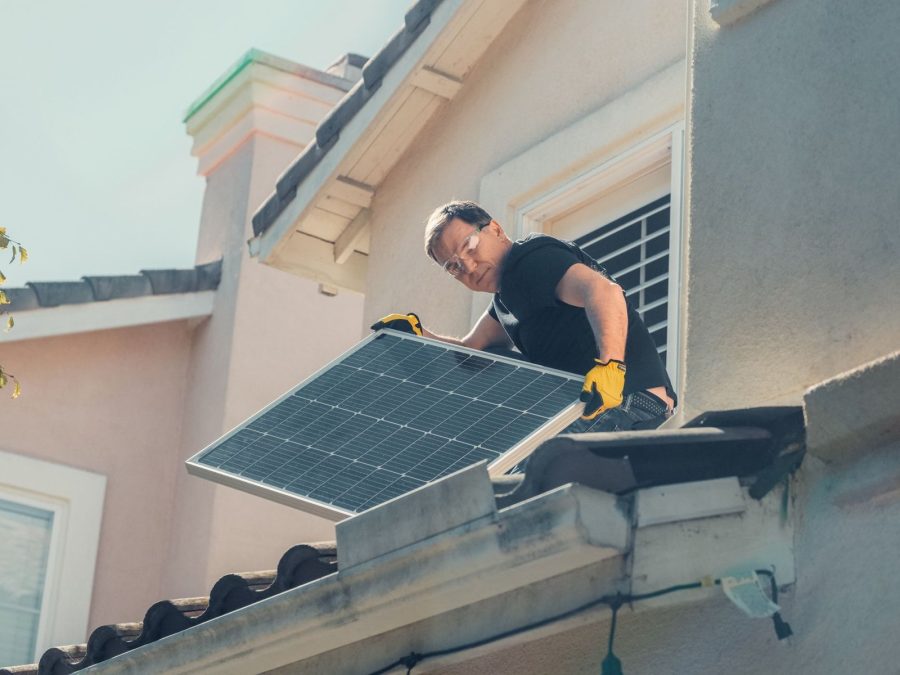
Solar panels should be installed by an installer certified under MCS, since MCS certification is a condition for export payments. The usual process is a survey and quote, system design, scaffolding, panel and inverter installation, connection to your distribution network and a certificate that you use to register for an export tariff. Do not attempt a roof installation yourself. Check any installer’s MCS status on the MCS website before signing a contract.
Frequently asked questions
What is the typical size of a home solar system?
DESNZ groups domestic installations into bands of 0 to 4kW and 4 to 10kW, and in 2025/26 there were 158,512 installations in the 0 to 4kW band and 91,953 in the 4 to 10kW band across all property types, which shows where most systems fall. The right size for you depends on your usage and roof.
How many solar panels do I need in the UK?
The number of panels depends on the capacity of each panel and the total system size you need. Ask an installer to design the system around your annual electricity use, then check the figure against the kilowatt size on the quote.
Are solar panels worth it?
That depends on the installed cost, how much electricity you use during the day and what your exports earn. The payback example above shows a range of roughly 9 to 11 years on stated assumptions. Get quotes and a predicted output for your own roof before deciding.
Will the cost go up after March 2027?
The zero VAT rate on installation is due to end on 31 March 2027 and revert to 5% from 1 April 2027 on HMRC’s current notice. The change adds to the cost of installations contracted after that date.
Share It on :